
Big Food, Big Bills
It was a good week for food monopolists


Welcome to You’re Probably Getting Screwed, a weekly newsletter and video series from J.D. Scholten and Justin Stofferahn about the Second Gilded Age and the ways economic concentration is putting politics and profits over working people.
A recent analysis by the Federal Reserve Bank of New York found that roughly 1 in 10 American families are skipping meals, punctuating the affordability concerns that have dominated recent election cycles. Grocery prices are up nearly 3% over the past year, piling on top of an increase well above 30% since 2020. The squeeze we are feeling at the grocery counter has presented an opportune moment to go after a root cause of these high prices, the extreme consolidation found throughout our food system. Food monopolies are not only harming consumers, but bankrupting family farms, small businesses and their rural communities. Yet in just the past week, these monopolists have been let off the hook several times.
On July 1 the Department of Justice and 18 states announced a settlement in a price-fixing investigation into major egg producers. The investigation found that Cal-Maine, Versova and Hickman’s had illegally coordinated for years to manipulate a daily price index for eggs, which drove up costs for retailers and ultimately consumers. The company executives face no criminal charges, will pay just $3.3 million in penalties, and donate around 50 million eggs. Matt Stoller in the BIG newsletter put that in context for Cal-Maine, the largest of the egg giants. “That means they are out $3 million for a scheme that netted them more than $3 billion.” This was very much a slap on the wrist, although that is a tougher stance than the other actions the administration has taken over the past week.
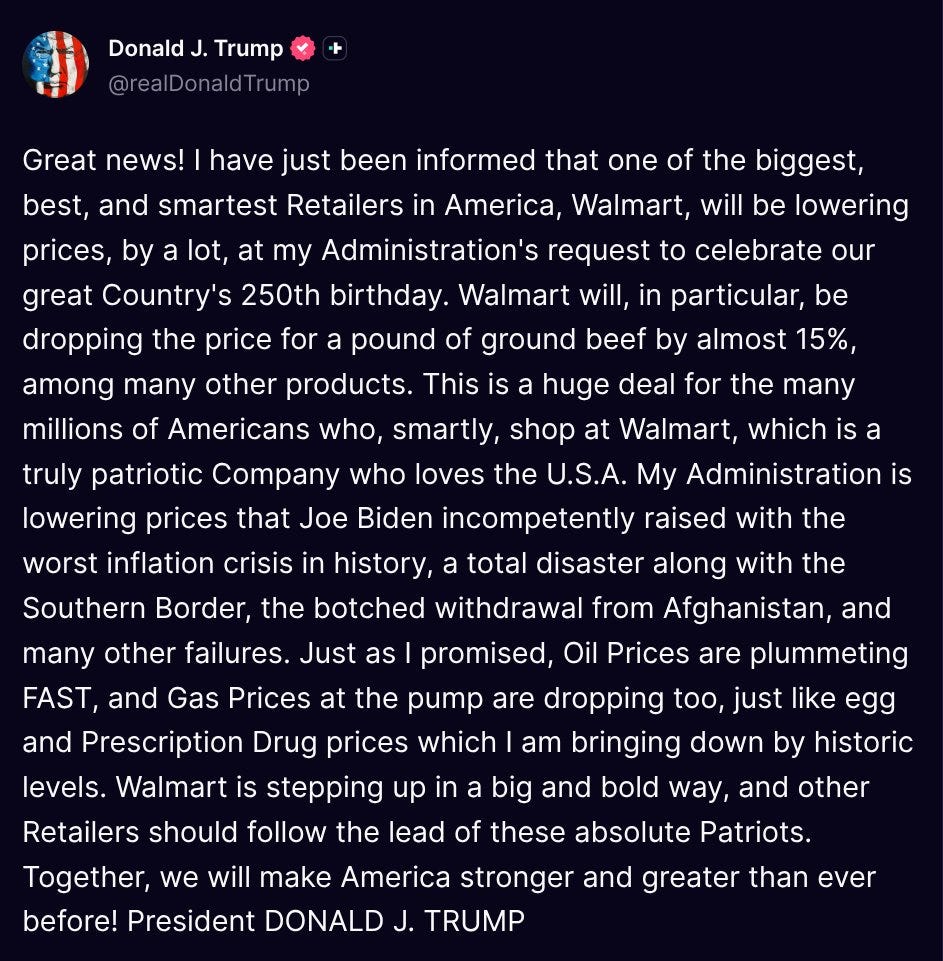
On Monday, President Trump announced on Truth Social that Walmart will be lowering its prices. Good news right? Well consider that beef prices have risen over 75% since 2020, so 15% off a massive increase seems like couch cushion stuff. Further, as Chris Jones of the Main Street Competition Coalition put it, “Walmart has only two ways to lower grocery prices. It can accept thinner margins (Wall Street won’t tolerate this) or it can squeeze suppliers harder. History points to the second.” Instead of a toothless handshake agreement, the Trump Administration had an actual opportunity to crack down on the unfair pricing practices dominant retailers like Walmart are using to hike prices and undermine competition.
Readers likely remember that the administration inherited an antitrust lawsuit from the Biden Administration detailing a scheme between PepsiCo and Walmart that violated the Robinson-Patman Act. That law prohibits price discrimination, or charging retailers different prices for the same goods, often at the behest of powerful retailers. What that case alleged was that Pepsi had acted as Walmart’s own personal price cop, monitoring soft drink prices at Walmart’s competitors (which are Pepsi costumers mind you) and raising their wholesale costs whenever those retailers’ shelf price got too close to Walmart’s.
This not only raises costs on those that shop at one of Walmart’s competitors and makes it incredibly difficult for those grocers to compete, but also means Walmart is not providing the truly lowest price for consumers. Rather it is establishing an artificially high price floor. As that complaint stated, “Rather than simply working with Walmart to reduce prices, Pepsi’s actions have had the effect of raising prices for customers of competing retailers.” Last year the Federal Trade Commission dropped the case. Instead of enforcing the law meant to ensure competition that can drive down prices, we get a Walmart press release from the president.
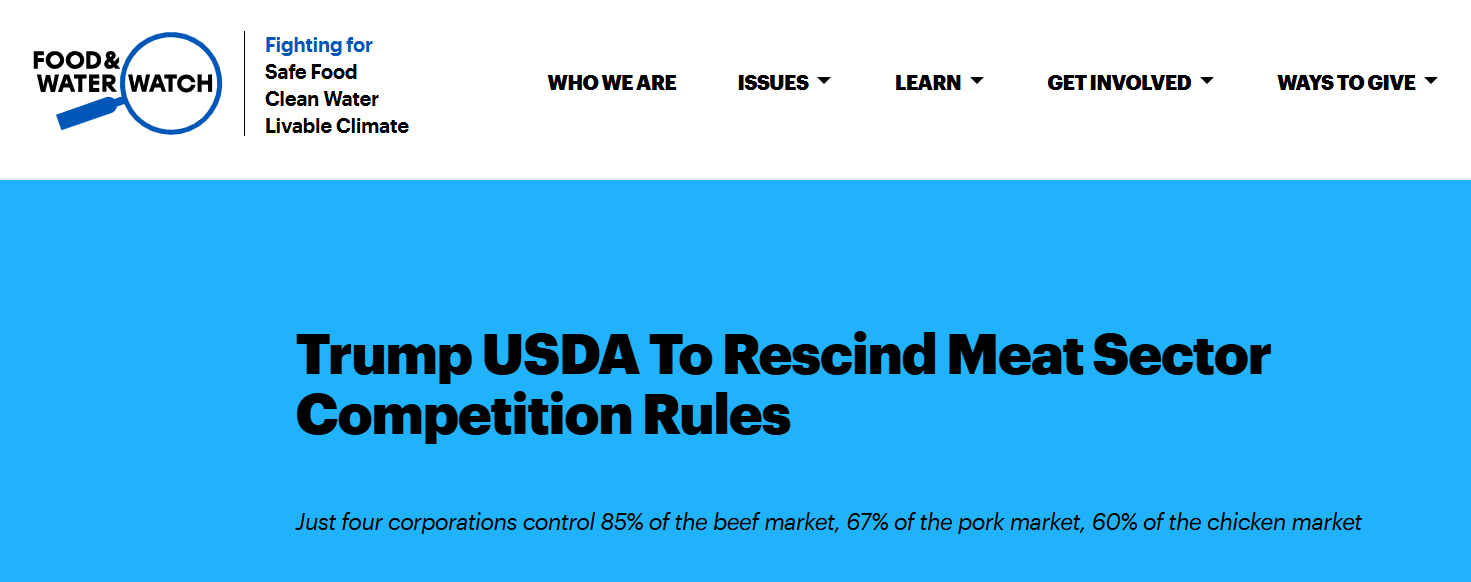
That was not the only news on Monday. The same day Trump posted about Walmart, his administration released a proposal to eliminate over 700 rules and regulations across the federal government. Among the rules on the chopping block are several from the United States Department of Agriculture (USDA) that would have strengthened the Packers and Stockyards Act, an antitrust law from the early 1920s meant to ensure fair competition in the livestock industry. While some thought the Biden Administration could have been bolder in its proposals, the rules were a meaningful step in dealing with the extreme consolidation in meatpacking where four giant corporations control anywhere from 50% to 80% of the poultry, pork and beef industries.
Among the livestock rules USDA now wants to eliminate, is one that aims to promote market competition throughout the livestock industry by protecting people at higher risk of unjust treatment, banning retaliatory practices, offering protection against deceptive contracts, and requiring more recordkeeping. The two other rules are specific to the poultry industry and increased pay transparency for contract farmers and improved the fairness of the pay systems for those farmers. History shows we can decentralize the meat processing industry by using antitrust tools like the Packers and Stockyards Act. This not only benefits farmers and ranchers as well as small and regional meat processors, but consumer prices as well. A series of private and public antitrust lawsuits in recent years have exposed price-fixing schemes across the industry, but now that consolidation seems poised to persist.
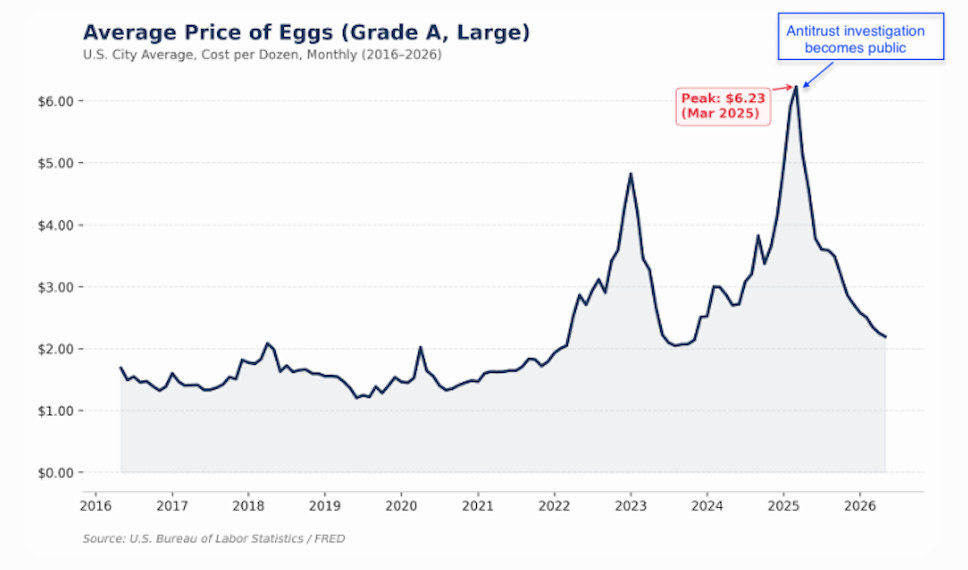
Is there an upshot here? Let’s go back to the egg cartel. While the administration might have bungled the settlement, as Stoller points out with the chart above, their investigation did lower prices. This is consistent with history. Consider President Franklin D. Roosevelt’s antitrust chief Thurman Arnold. Under Arnold the Antitrust Division found that simply launching an investigation into an industry lowered prices by 18-33%, helping tame inflation and pull the country out of recession. Of course settlements like the egg one undermine that effectiveness. These egg executives put their scheme in writing and now get a slap on the wrist. What message will that send to the rest of America’s price-gouging monopolists? But again, investigations can be impactful and state attorneys general should launch more of them!
This is also an opportunity for states to take the lead on tackling the food monopolists. Consider two bills from this past year in my home state of Minnesota. The Consumer Grocery Pricing Fairness Act (introduced in other states as well) would create a stronger state-level version of the Robinson-Patman Act for grocery. This would give the state the ability to crack down on price discrimination along with some of the unfair practices the federal law does not cover. There was also legislation put forth that would prohibit big retailers from owning meat processing facilities. That kind of vertical integration, which Walmart has dipped its toe into, would combine the power of consolidated retailers with consolidated processors and the losers would be consumers, small businesses and ultimately communities.
While I’m highlighting Minnesota, other states can pass these bills!
“Since at least the pandemic, packers have squeezed farmers, suppressed workers and continue to raise costs for the American consumer. I support the retail packer ban to begin to balance the power of the American farmer, worker and consumer.” - Iowa State Representative JD Scholten
While the federal government might not be dealing with the food giants that are screwing us, the states certainly can. Candidates for governor, attorney general and the legislature should all take notice if they want to channel the country’s populist anger towards a solution to high food prices.
YOU’RE PROBABLY (ALSO) GETTING SCREWED BY:
Big Tech
Not new, but I just recently came across this interview Jon Stewart had with attorney Cindy Cohn who argues consumer solutions to Big Tech’s surveillance state are the wrong way to think about how to protect us from Big Tech because the game is rigged against us and we need laws and policy to fix the problem.
Digital Media
Speaking of Big Tech, those companies, not the internet, have ruined the news industry. As a baseball nerd one of my favorite websites is Fangraphs, which covers the statistical side of baseball. Recently Fangraphs founder David Appelman has written a “State of Fangraphs” piece each year giving readers a peak under the hood of the business. Whether you are a baseball numbers junkie or not, I would consider giving it a read, because it is an always illuminating look into the struggles of running a digital media outlet these days.
Sony
The idea of ownership continues to fade away. Sony recently announced that beginning in January 2028, it will cease producing physical Playstation games. This means all games will be digital. Part of this is legitimately a reflection of consumer sentiment as some 80% of Playstation game purchases are digital, but as Washington Post Culture Critic Gene Park told CNN, “This is not an issue about discs, it’s an issue about consumer ownership and consumer rights.” Everything is a subscription!
Consumer Debt
We have covered the policy reasons for why Americans are drowning in debt these days, but here is a short clip on the Supreme Court decision that helped unleash the predatory debt trap we know today.
The Insider Trading Economy
One of the coolest parts of my day job is getting to work with Minnesota State Representative Emma Greenman who joined Matt Stoller and David Dayen for a fascinating conversation on the Organized Money Podcast about how states can attack corporate power. Check it out!
SOME GOOD NEWS:
The Antimonopoly States of America
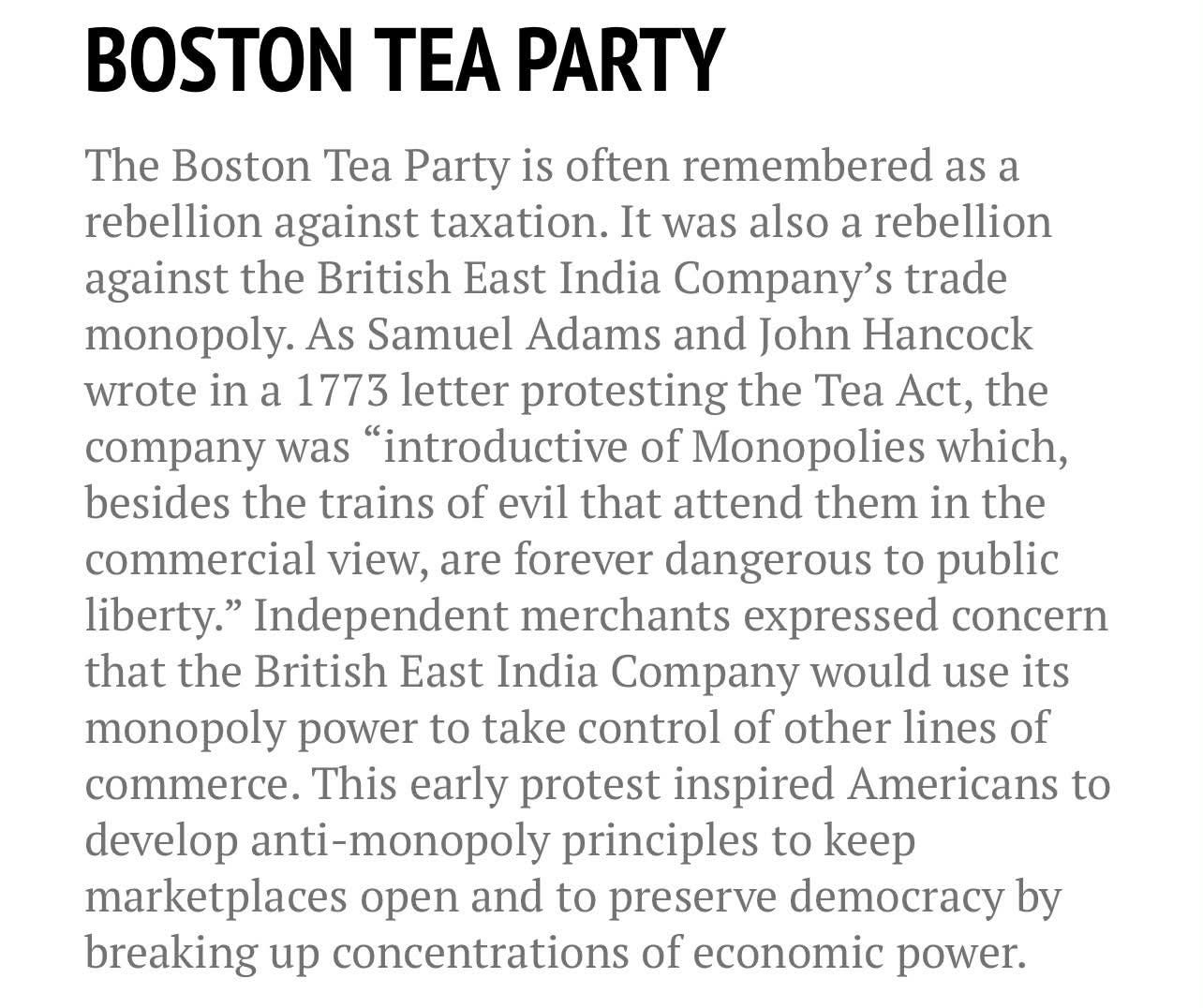
Things are admittedly rough out there as we celebrate 250 years of America. That said, what keeps me going in these fights against corporate power is the proud American tradition of taking on monopolists. Antimonopoly is as American as Apple Pie. Consider what Thomas Jefferson wrote as our founders debated our nation’s Constitution. “It is better to abolish monopolies, in all cases, than not to do it in any.” While we ultimately ended up not constitutionally prohibiting monopoly, it is another example of how our country’s founding was inspired by that fight. Check out the Open Markets Institute’s Anti-monopoly Timeline for more inspiration.
BEFORE YOU GO
Before you go, I need two things from you: 1) if you like something, please share it on social media or the next time you have coffee with a friend. 2) Ideas, if you have any ideas for future newsletter content please comment below. Thank you.
Break Em Up,
Justin Stofferahn
The problem with FTC lawyer that settled the Calmaine case in their favor is himself a pro-corporatist, he pushed to dismiss Calmaine case earlier with less penalties but was boxed in bc the train was already in motion, he will not start more investigations without enormous outside political pressure, and even then he will try to sabotage them with every step. Just a typical establishment R getting paid big money by the monopolists.
I have avoided Walmart for years. It was my understanading that there employees were not treated fairly or with respect.